
Students from the Civil Engineering Department at the University of Louisiana at Lafayette recently participated in
UL Lafayette Doctoral Researchers Shine at ASCE Structures Congress 2026
Thu, 06/11/2026 - 4:28pm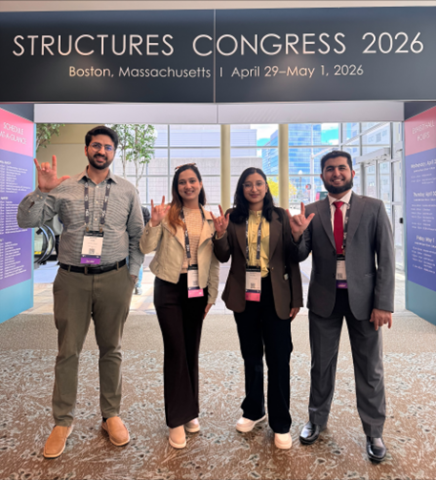
PhD researchers Sherbaz Khan and Afsar Ali represented the University of Louisiana at Lafayette on the national stage, presenting groundbreaking research in AI-driven structural health monitoring and bridge deterioration prediction at one of the country's premier structural engineering conferences.
The ASCE Structures Congress 2026, held April 29 through May 1 in Boston, Massachusetts, brought together leading researchers, engineers, and practitioners from across the country. Among the speakers were two PhD candidates from UL Lafayette’s Department of Civil and Environmental Engineering, both members of Dr. Li Hui’s research group. Other graduate students, Upasana Khadka and Tania Lamichhane also accompanied them. Both researchers delivered technical presentations in specialized sessions, showcasing research conducted at UL Lafayette that addresses critical challenges in modern infrastructure monitoring and management.
BRIDGE AI & MACHINE LEARNING, Contactless Vibration Based Damage Detection Integrating Stereo Vision 3D Displacement with Physics Informed Neural Networks
Sherbaz Khan
PhD Student, Systems Engineering
University of Louisiana at Lafayette
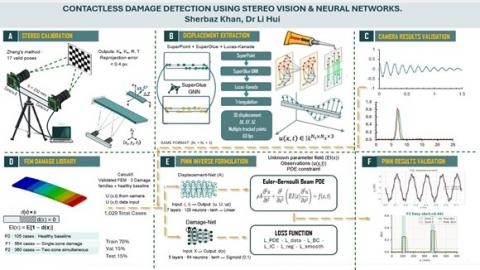
Sherbaz Khan’s research addresses a fundamental challenge in structural health monitoring: how to detect and localize damage in structures without physical sensors attached to the structure itself. His framework integrates stereo camera vision to capture full-field 3D displacement data at up to 60 frames per second, combined with Physics-Informed Neural Networks (PINNs) to solve the inverse problem of identifying damage location and severity.
The system employs a deep learning pipeline for high precision displacement extraction, feeding into a dual network PINN architecture, a Displacement-Net and a Damage-Net governed by the Euler-Bernoulli beam PDE. Validated against a finite element model library of over 1,000 damage cases, the framework demonstrates the potential for truly contactless, vision-based structural health monitoring on a scale.
BRIDGE SHM / DIGITAL TWINS, AI-Driven Bridge Deterioration Prediction Using a Spatiotemporal Deep Learning Framework
Afsar Ali
PhD Student, Systems Engineering
University of Louisiana at Lafayette
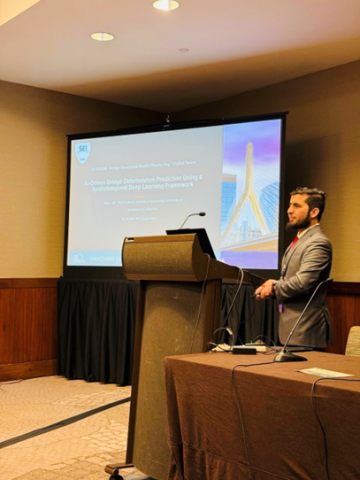
Afsar Ali’s research tackles the long-term challenge of predicting bridge deterioration before it becomes critical. Leveraging over four decades of National Bridge Inventory (NBI) data spanning 1980 to 2025, his spatiotemporal deep learning framework models how bridge condition ratings evolve over time under the influence of traffic, aging, environmental exposure, and maintenance interventions.
The framework employs a rigorous feature engineering pipeline including correlation analysis, p-value validation, and multi-method selection with EWRA-based ranking to extract the most predictive signals from the vast NBI dataset. The resulting model provides accurate, consistent deterioration predictions that can directly support maintenance planning and resource allocation decisions by transportation agencies.
Research supervised by Dr. Li Hui, whose research group at the University of Louisiana at Lafayette focuses on advancing intelligent infrastructure monitoring systems. Both Sherbaz Khan and Afsar Ali are members of Dr. Hui's group, and their presentations at Structures Congress 2026 reflect the rigorous, application-driven research culture he has fostered.
About the Researchers
Sherbaz Khan
Sherbaz Khan is a PhD student in Systems Engineering at the University of Louisiana at Lafayette. His dissertation research focuses on AI-driven damage detection and localization for bridge structural health monitoring, with expertise spanning deep learning, computer vision, Physics-Informed Neural Networks, and accelerometer signal processing. He has six peer-reviewed journal publications and has presented at the Transportation Research Board (TRB) Annual Meeting and the Louisiana Transportation Conference.Afsar Ali
Afsar Ali is a PhD student in Civil and Environmental Engineering at the University of Louisiana at Lafayette. His research leverages large-scale transportation datasets and spatiotemporal deep learning to develop predictive frameworks for bridge condition management, with the goal of enabling proactive, data-informed maintenance decisions by transportation agencies.